
Current Impact of AI Use on the Threat Landscape
AI adoption changes organizational risk exposure by introducing vectors that are uncommon in traditional software and require a different governance and control model. Practically, AI reduces the ability to validate and constrain fully (1) the information processed or disclosed, (2) the technical/strategic basis for decisions, and (3) the effective security perimeter when external tools and providers are involved. Risk materializes when AI outputs are used to trigger concrete actions, especially in automated workflows or integrations with critical systems.
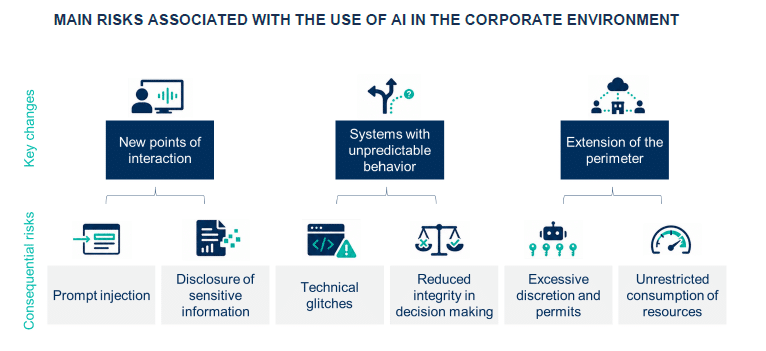
Risk is not purely technical and emerges from the combination of AI with data, processes, and automation, especially when governance and oversight are weak. The identified risks map to three structural shifts introduced by AI:
› Untrusted inputs in-band (new interaction points): AI pulls context from multiple external sources, so uncontrolled content can be interpreted as instructions inside internal workflows.
› Non-deterministic behavior under adversarial context: LLMs interpret context variably, implicitly prioritize instructions, and may hallucinate or produce plausible but incorrect outputs.
› Expanded tool/perimeter surface: AI integrations extend the operational perimeter to external providers, connectors, and services, increasing the scope of execution outside direct organizational control.
This is just a preview of the report “The Current Impact of AI on the Threat Landscape” prepared by our Cyber Intelligence team.
If you would like to learn about the 10 critical threats associated with the use of AI technologies by malicious actors, as well as real-world examples of attack techniques and tactics that are already being enhanced by AI, download the full report: